
An exciting new chapter for the PPCoC
Earlier this year, our CEO, Amber Ptak, shared why ChangeLine was stepping away from its role as System Lead for the Pikes Peak Continuum of Care (PPCoC). On July 1, those responsibilities transitioned to Pikes Peak United Way (PPUW), in close partnership with the City of Colorado Springs.
ChangeLine has been honored to serve in this role since 2018 and we’re excited about what this means for our community.
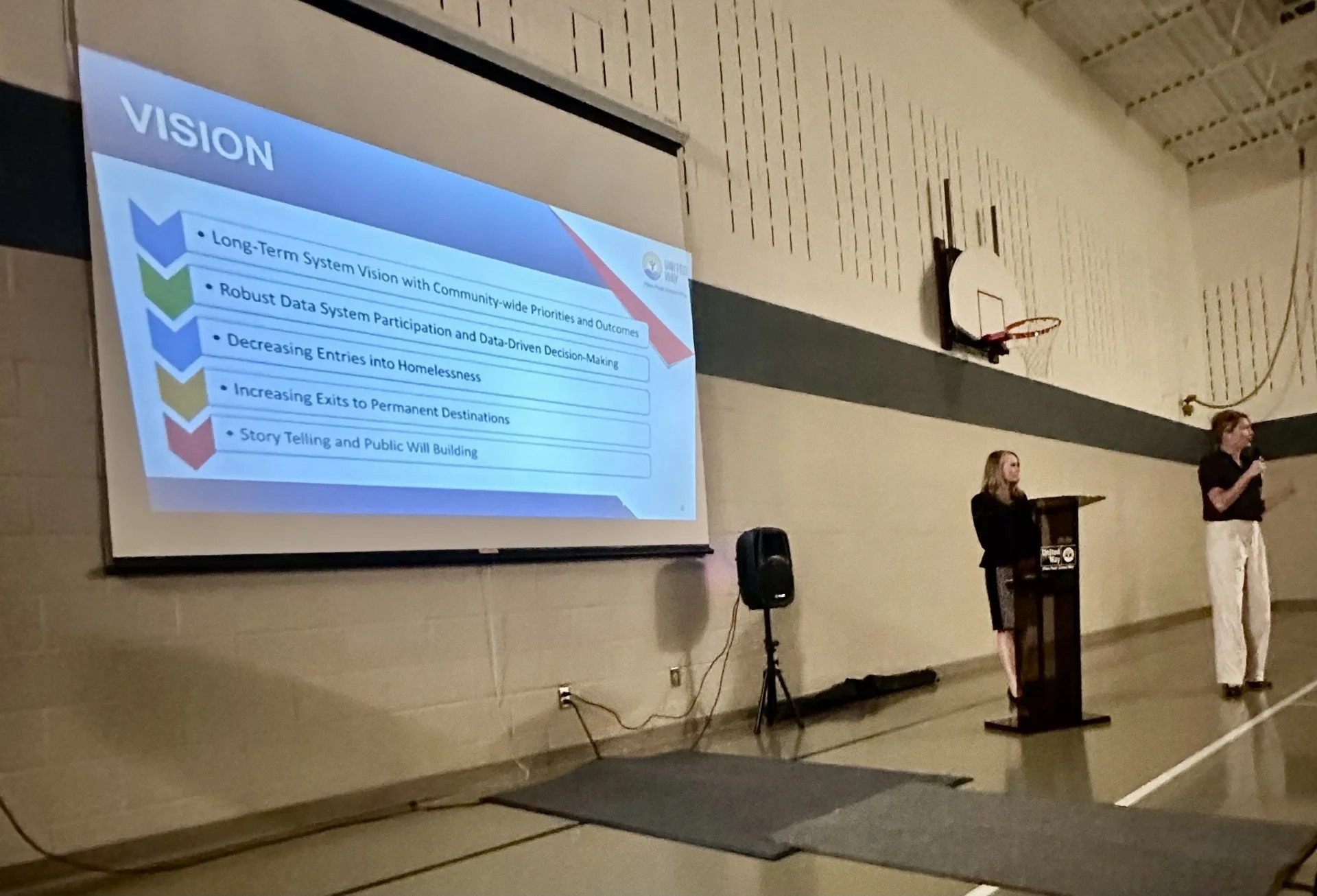
At June’s PPCoC membership meeting, Cami Bremer and Aimee Cox outlined a collaborative vision for supporting the community's response to homelessness.
Congratulations to PPUW and the City on this new chapter, and sincere thanks to Cami Bremer, President and CEO of PPUW, and Aimee Cox, Chief Housing Officer for the City, for the leadership, vision, and commitment they bring to this work.
We also want to recognize the PPCoC Board. They spent the last two years working through a thoughtful, strategic process that examined what this community needs, what structure would best support it, and what entity or entities were positioned to provide it.
Finally, even though it happened for all the right reasons, this change is bittersweet. We already miss our coworkers and friends who served in the HUD-funded roles that were part of this transition. There’s no way to thank them enough for the difference they made in the community and to all of us at ChangeLine. We wish them the best and we know they will continue doing great things.
Where it began
We are deeply honored to have had the privilege of serving in this role for the last eight years. ChangeLine (then Community Health Partnership) became System Lead for the PPCoC in 2018, supporting a network of more than 100 organizations working to prevent and end homelessness in the Pikes Peak region.
This role acts as the backbone of that network: managing federal compliance, stewarding data systems, and holding together a common vision of a coordinated community response. From the beginning, we believed the PPCoC could be more than just a compliance structure; that it could actively drive systemic change across the whole community. But believing something is possible isn't the same as knowing how to make it happen. We learned more than we could have imagined, and we want to share some of that here.
Building the foundation
As we reflect on the last eight years, there's a lot we're proud of. Working alongside the PPCoC, we rebuilt governance from the ground up, with a new charter, new accountability agreements, eight active committees, and a board that looks more like the community it serves.
Participation in the Homelessness Management Information System (HMIS) doubled, including significant voluntary participation, which is rare for a community our size. The data practices developed here are now being shared with HMIS leads across Colorado.
Changes to Coordinated Entry pushed successful housing referrals up by more than 60 percent. Focused case conferencing and monthly convenings of a dedicated Veteran Improvement Team increased agency coordination, partnership, and communication, leading to a significant drop in veteran homelessness.
People with lived experience have been increasingly centered in governance and program design. That work isn't finished, and we certainly haven’t done it perfectly, but it's getting noticed beyond our region. A Minnesota-based group that focuses on lived experience in systems change came to the Pikes Peak region specifically to study how this community does it.
But what we’re most proud of aren’t the obvious “wins.” They’re only part of the story. What we’re most proud of is a lot messier, and probably more important to share.
The lessons we learned
During our tenure, we convened people, managed compliance, and built systems. It looked like collaboration in a lot of ways but it was really coordination. While coordination is important, it isn't the same as collaboration, and the gap between the two is where we learned the most.
Genuine collaboration involves sharing accountability, risk, and ownership, and it never fully actualized while we held the role. It can’t be funded or “complianced” into existence. Collaboration grows when we create the conditions that allow relationships to form, trust to build, and a common purpose to take root.
Our experience as the System Lead fundamentally changed how we approach our work, and we've carried this into everything else we’ve done since. We’ve learned to:
Invest in relationships first. Trust is what makes collaboration possible, and trust can’t happen without intentionally building and sustaining relationships.
Go slow to move fast. We’ve all heard this saying, but it’s hard to do when the needs of the people we serve are immediate. But rushing to a solution before we understand the problem often creates motion that feels like progress but doesn't last.
Engage those closest to the problem. They can see what's broken and what's missing more clearly than anyone looking at a spreadsheet. Leaving them out isn't just an equity problem, it's a strategic mistake. And bringing them in has to mean something. A seat at the table without any real influence isn't inclusion.
Be honest about power. Every collaboration has power running underneath it: who has influence, how decisions really get made, whose priorities set the agenda. Being honest about these dynamics makes it possible to start shifting them, and to build a table where more diverse voices shape what happens.
The opportunities ahead
The one thread that runs through all of this is that complex issues like homelessness are too big and too complicated for any single organization to carry alone. This new structure, with responsibilities shared across partners who each bring something different, is built around exactly that.
For PPUW and the City, this is an opportunity to build on a foundation that’s more solid than it’s ever been. The board is informed, engaged, and ready to lead. The network has developed a shared language and trust in a common set of data. And they’ve chosen a set of values—tenacity, connection, trust, openness—they’re genuinely aligned with.
For ChangeLine, this new structure lets us do more of what we’re built for: convening partners, engaging community voices, bridging differences, and building the collaborative infrastructure necessary for systemic change.
What's possible together
As our community moves into this exciting new chapter, we believe the Pikes Peak region is closer than it's ever been to making homelessness rare, brief, and nonrecurring. Not because of any one organization or any one decision, but because enough people here have decided to build it together.
We’re grateful to have been part of it, and we look forward to continuing alongside all those who are committed to carrying it forward, for as long as it takes.